 Gridsense Docs
Configure Data Channels
Learn how to create and configure channels to facilitate device communication
Requirements
To provision channels, you will need to:
- be a member of an organization, and
- have been granted a role with channel creation permissions.
For example, to provision channels, You will need
to be a member of any role with the channel_create permission.
If you are the administrator of the organization, you will have all permissions already granted to you. Otherwise, if you have been invited to the organization, you can request from your administrator to grant you the appropriate role.
Provisioning
You can provision channels in bulk or one by one.
Provisioning a single channel
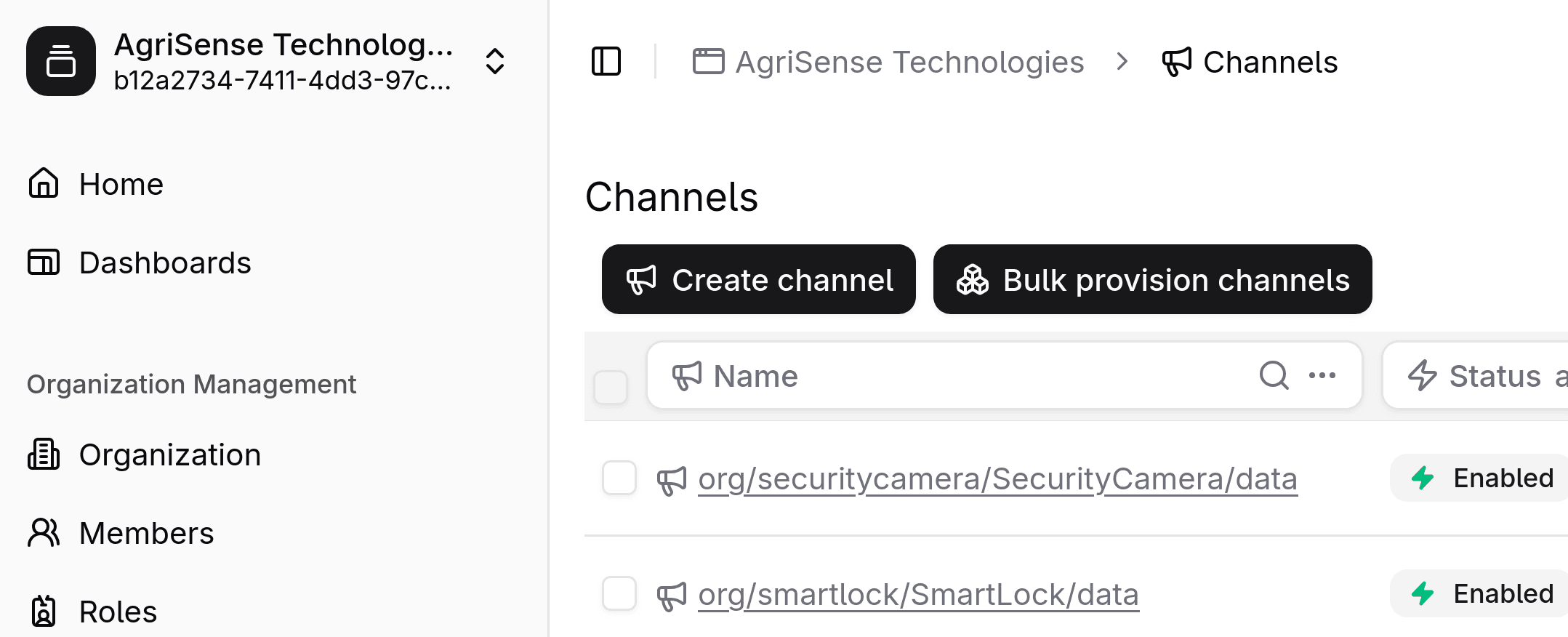
Head over to the channels page. Click on "Create channel." In the dialog that pops up, you will be prompted to provide the channel's information.
Here are the details of each field:
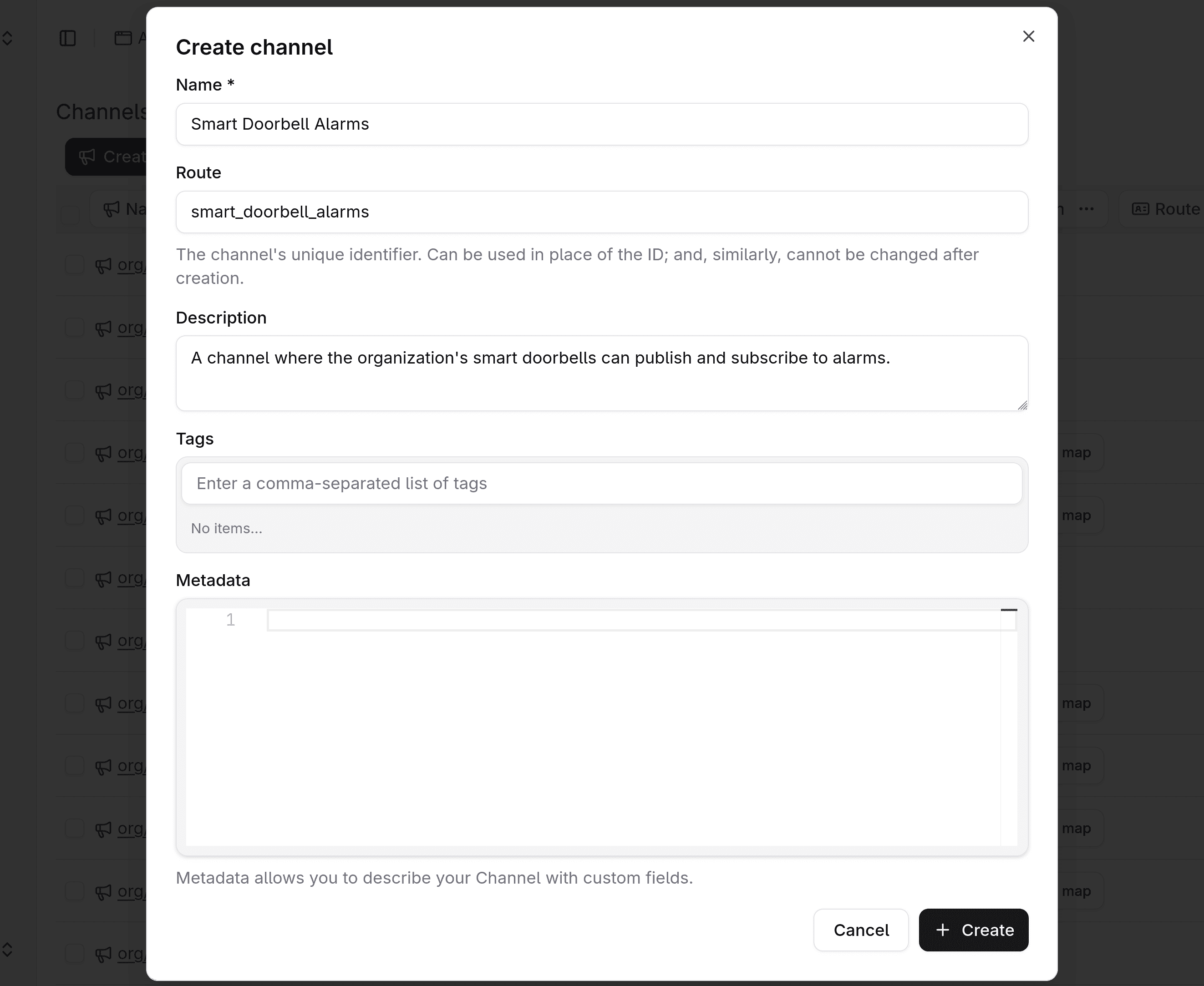
| Field | Description | Example | Required |
|---|---|---|---|
| Name | The display name of the channel. | "org/smartlight/SmartLight/data" or "My Channel" | |
| Route | The channel's unique identifier. Can be used in place of the ID; and, similarly, cannot be changed after creation. | smart*light | |
| Description | A description of the channel. | *"A channel used by smart lights and related devices"_ | |
| Tags | A comma-separated list of tags. Can be helpful when filtering and searching. | home, lighting, automation | |
| Metadata | A JSON object that describes the channel. Note that the property location is reserved by Gridsense to allow maps to work properly. | {"room": "1F"} |
Provisioning multiple channels (bulk provisioning)
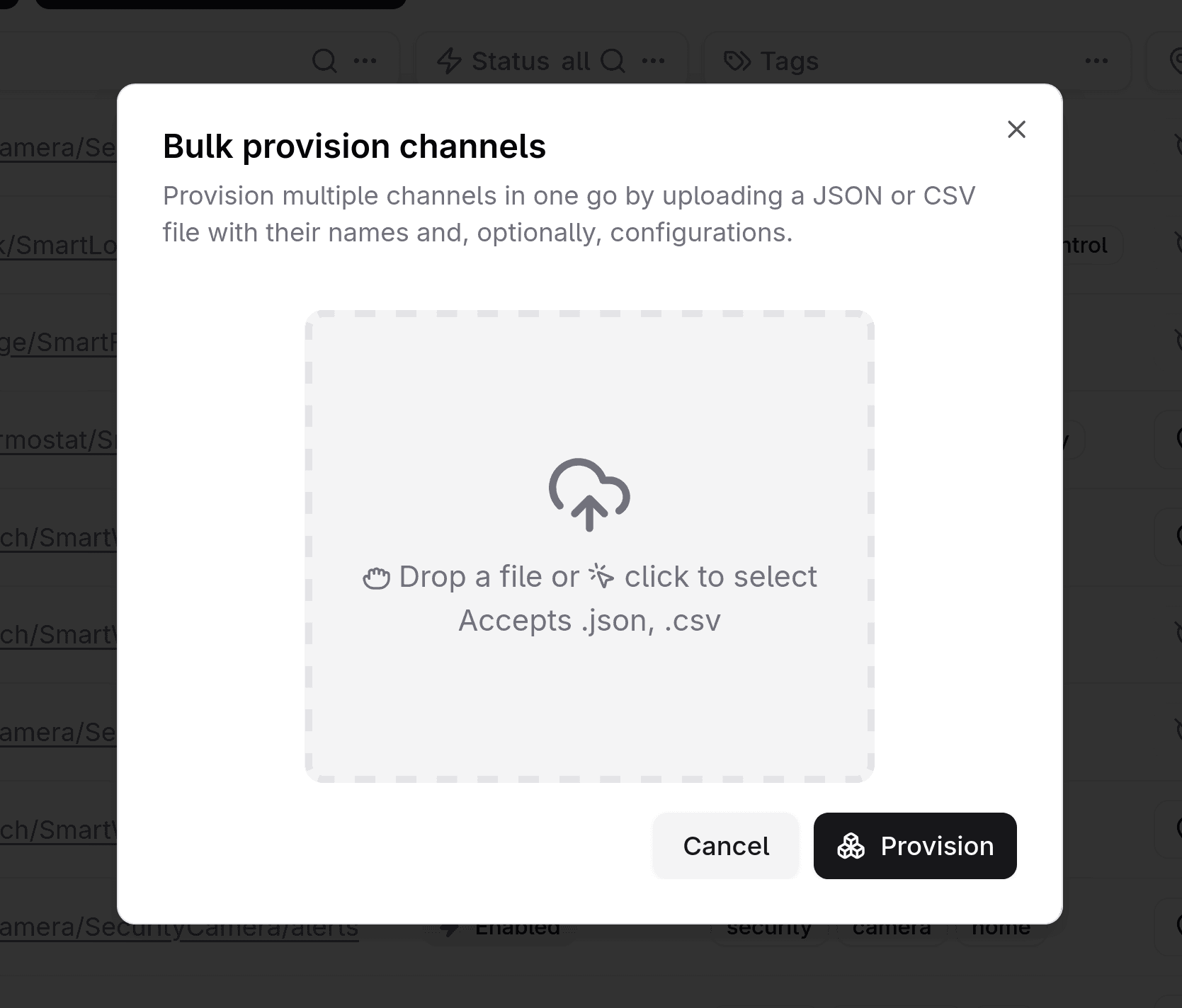
Head over to the channels page. Click on "Bulk provision channels." In the dialog that pops up, you will be prompted to upload a file that contains the information of one more more channels. You can click to open the file selector or drag and drop the file directly. The file can be either JSON or CSV, and must conform to the schema of each file.
JSON file schema
The JSON file must be an array of objects. Each object must follow the following schema:
| Field | Description | Example | Required |
|---|---|---|---|
| Name | The display name of the channel. | Smart Light | |
| Tags | A JSON array of tags. Can be helpful when filtering and searching. | ["home", "lighting", "automation"] | |
| Metadata | A JSON object that describes the channel. Note that the property location is reserved by Gridsense to allow maps to work properly. | {"room": "1F"} |
Example JSON file
[
  {
    "Name": "org/smartlight/SmartLight/data",
    "Tags": ["home", "temperature", "energy"],
    "Metadata": {
      "room": "1F"
    }
  },
  {
    "Name": "org/smartlock/SmartLock/alerts",
    "Tags": ["security", "home"]
  }
]
CSV file schema
The first row of the csv file must be the header. There are three columns:
| Field | Description | Example | Required |
|---|---|---|---|
| Name | The display name of the channel. | Smart Light | |
| Tags | A JSON array of tags. Can be helpful when filtering and searching. | ["home", "lighting", "automation"] | |
| Metadata | A JSON object that describes the channel. Note that the property location is reserved by Gridsense to allow maps to work properly. | {"model":"SL2025", "warranty": "void"} |
Make sure the headers are properly capitalized; e.g. you should write Name
and not name.
Although only the Name field is required, the other column headers (Tags and
Metadata) must be present, even if all rows leave them blank.
Example CSV file:
| Name | Tags | Metadata |
|---|---|---|
| org/smartthermostat/SmartThermostat/data | ["home","temperature","energy"] | |
| org/securitycamera/SecurityCamera/alerts | ["security","camera","home"] |
Finish provisioning
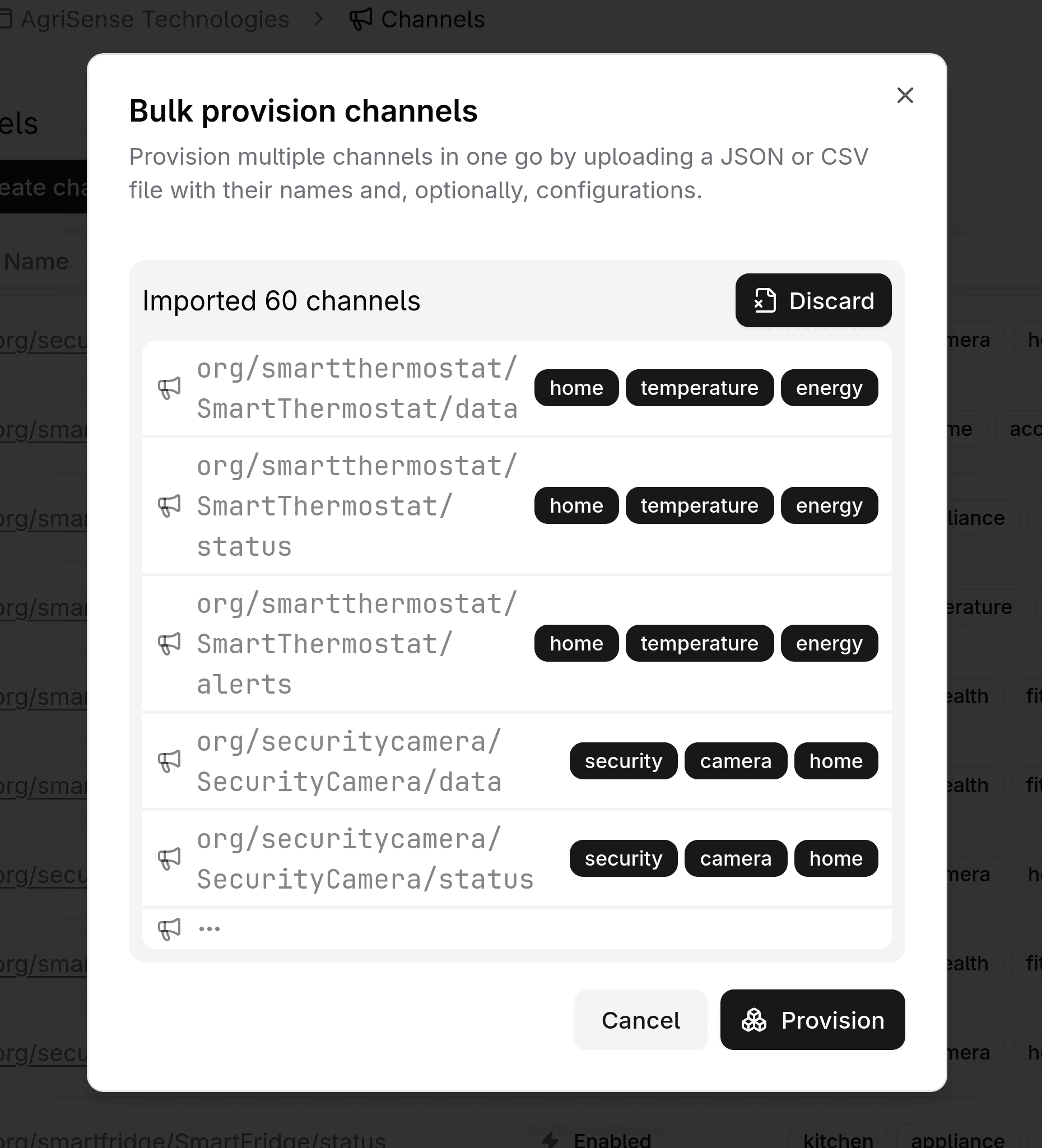
Once you have imported the JSON/CSV file, you will see a preview of the first five channels. You can complete the provisioning step by clicking "Provision." If you are unsatisfied with the result or would like to make changes, you can click "Discard" to start over.
Recommended approach
The recommended approach to channel creation is to create two channels; one for telemetry (continuous sensor readings, live data, etc.) and another for events (one-off events like object detection).
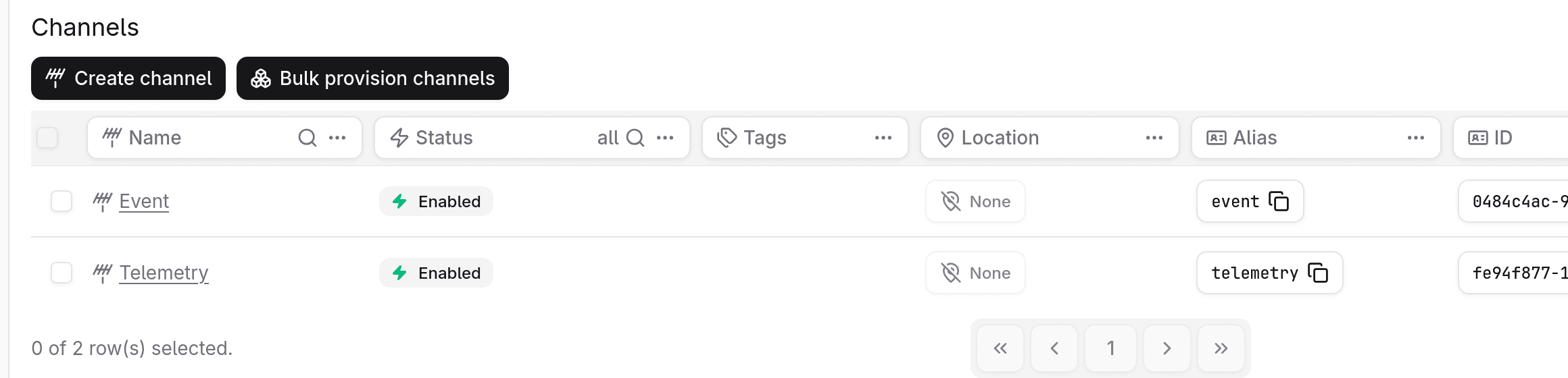
Once you have created the two channels, you can connect each device that you provision afterwards (or have already provisioned) to both of them. This allows you to share your messaging setup (e.g. MQTT scripts) across all your devices so you can think only about the messages and sensor readings themselves.